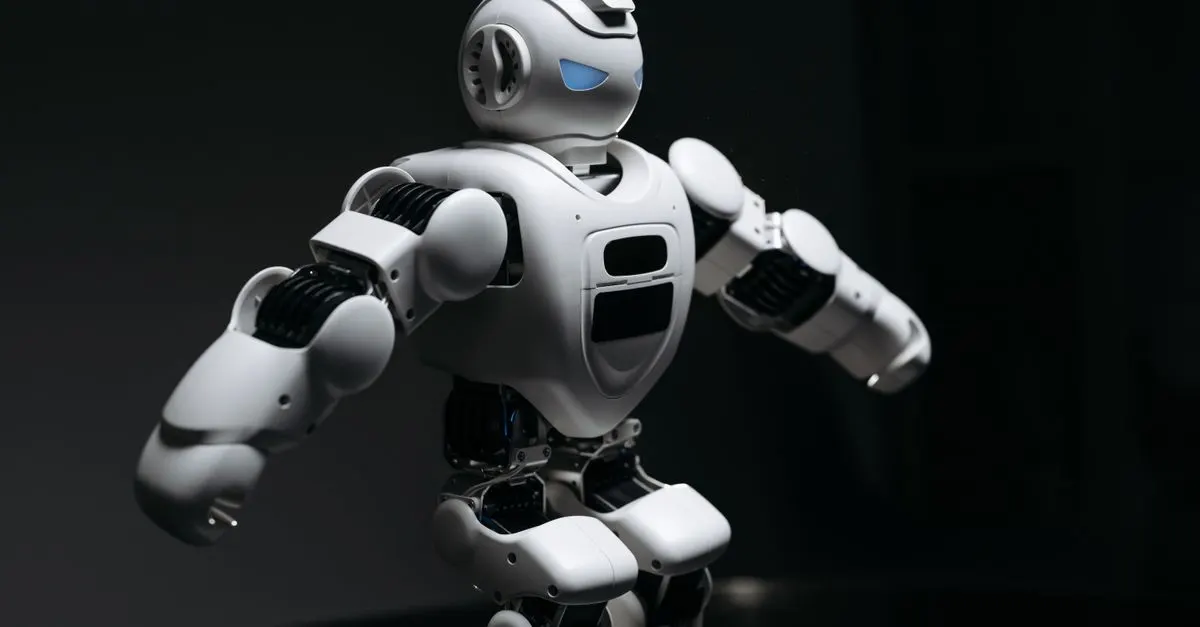
A team of researchers has successfully adapted advanced control methods previously available only on expensive, full-sized humanoid robots to much smaller and more accessible platforms. The work addresses a significant gap in robotics research by bringing sophisticated remote operation and autonomous learning capabilities to miniature humanoids that cost a fraction of their larger counterparts.
The key innovation lies in combining two complementary control approaches: virtual reality teleoperation for upper-body manipulation and reinforcement learning algorithms for lower-body balance and movement. This hybrid strategy allows a single human operator to see and interact with a distant environment while the robot independently manages the complex task of staying upright and moving around obstacles.
Democratizing Advanced Robot Control
According to arXiv, the research team, led by Nicolas Kosanovic, Jordan Dowdy, and Jean Chagas Vaz, developed a complete control framework specifically engineered for miniature humanoids. Their approach differs from existing systems in that it was built from the ground up for smaller form factors rather than simply scaled down from larger designs. This distinction matters because miniature robots typically have fewer sensors, limited degrees of freedom, and different mechanical constraints than their full-sized counterparts.
The team tested their system on the ROBOTIS OP3, a widely used research platform standing about 45 centimeters tall. Experimental results demonstrated the robot could walk at speeds up to 0.45 meters per second while independently controlling its arm movements. The system proved stable enough for complex coordinated tasks combining walking and object manipulation.
Practical Demonstration of Real-World Tasks
To validate the approach, researchers conducted a tele-loco-manipulation experiment where a human operator controlled the robot to move small cube-shaped objects across a workspace. Using the VR interface, the operator could see the robot's environment and direct its movements. Over a 10-minute session, the system successfully relocated two 40-gram cubes while traversing a total distance of 5 meters. The task requires simultaneous management of locomotion, arm positioning, and object grasping, making it a rigorous test of the control architecture.
Why This Matters for AI and Robotics
- Accessibility: Advanced control methods become available to research teams without access to million-dollar robots
- Scalability: Successful miniature implementations could lead to better understanding of what makes humanoid control effective
- Cost efficiency: Smaller platforms cost significantly less to purchase, maintain, and operate
- Learning potential: Reinforcement learning systems can be trained on cheaper platforms before deployment on expensive hardware
The research points toward a future where sophisticated robotic capabilities are not exclusively the domain of well-funded corporations. By proving that VR teleoperation combined with machine learning can work effectively on modest hardware, the authors open doors for broader participation in humanoid robotics development and experimentation.
While the current system shows promise, researchers acknowledge this represents an early demonstration. Future work will likely focus on improving task speed, expanding the complexity of manipulation activities, and refining the balance between human control and autonomous decision-making. The work suggests that the most advanced robot control techniques may not require the most advanced robotic hardware.