Computer scientists have challenged a fundamental assumption about how to build large language models, demonstrating that allocating computational resources unevenly across network layers can improve both efficiency and performance.
Conventional transformer architectures, which power systems like ChatGPT and Claude, typically maintain identical width (the number of parameters and computational units) throughout all layers. This uniform approach treats every layer equally, despite evidence suggesting that different depths serve different purposes in processing information. According to arXiv, a team of researchers led by engineers at MIT-IBM Watson AI Lab and other institutions tested whether a deliberately asymmetrical design could achieve better results.
The Hourglass Approach
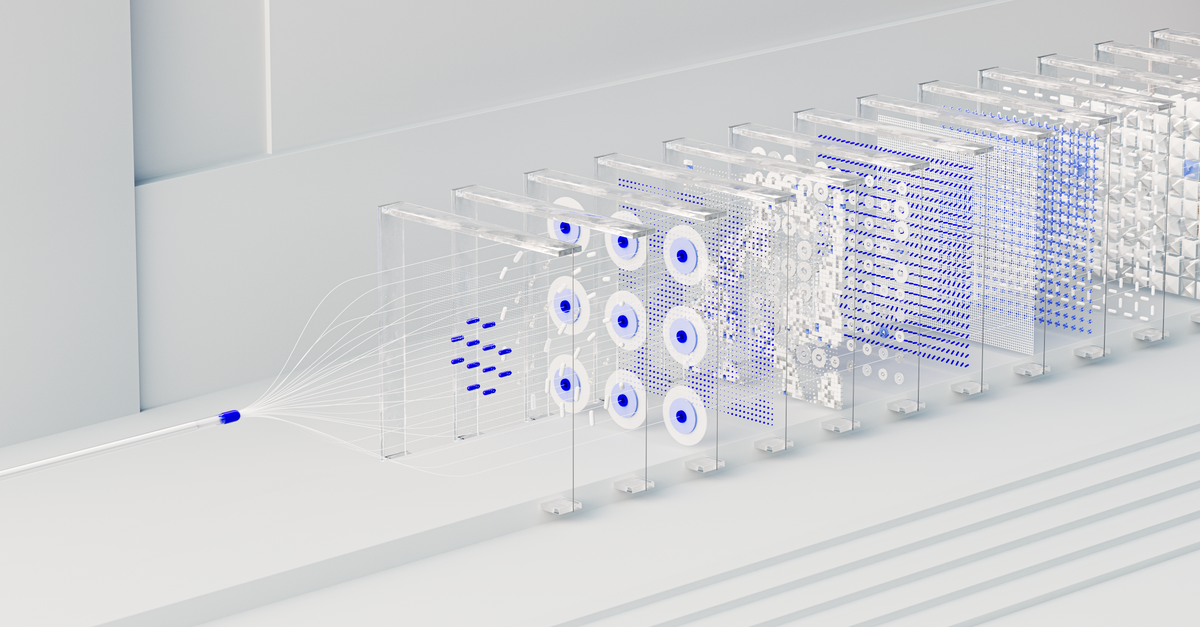
The researchers proposed an architecture shaped like an hourglass or X, keeping earlier and later layers wide while narrowing the middle section significantly. This design maintains identical parameter counts to standard models while redistributing those parameters strategically across the network depth. The team employed a parameter-free mechanism to resize information flowing between sections, eliminating additional complexity.
Testing across model scales from 200 million to 3 billion parameters, the bottleneck architecture consistently outperformed traditional uniform-width baselines on language modeling benchmarks. More notably, it achieved these improvements while using substantially less computational power and memory.
Measurable Resource Gains
The efficiency benefits proved substantial:
- 22% reduction in computational operations (FLOPs) needed to reach equivalent performance levels
- 15% decrease in memory requirements for storing cached information during inference
- Lower input/output overhead when running the model on hardware
These savings matter significantly for deploying language models. Reduced computational demands lower energy consumption and hardware costs, while decreased cache memory requirements enable running larger models on resource-constrained devices.
Why This Matters
The research suggests that current scaling strategies for language models, which have driven impressive capability improvements, may not be optimal from an efficiency standpoint. As organizations race to deploy increasingly capable AI systems, discovering architectural changes that improve performance while reducing resource consumption could accelerate both commercial deployment and research progress.
The asymmetrical structure also produced interesting theoretical findings. The bottleneck design generated qualitatively different representation patterns in the residual streams (the information pathways connecting layers), suggesting the architecture fundamentally processes information differently than conventional designs.
"Our results demonstrate that nonuniform width allocation can result in more resource-optimal scaling of language models," the researchers concluded, indicating this approach could reshape how engineers design future systems.
The work builds on growing recognition that the path to better AI systems may not simply involve making models larger. Recent advances have shown that thoughtful architectural changes, training techniques, and resource allocation strategies can sometimes outperform brute-force scaling. This research extends that principle to the fundamental structure of transformer networks themselves.
As competition intensifies around AI capability and efficiency, these findings could influence how the next generation of large language models gets constructed, potentially shaping the economics and environmental footprint of advanced AI systems.